beauty the brave

Standard

Peonies
Mary Oliver

This morning the green fists of the peonies are getting ready
to break my heart
as the sun rises,
as the sun strokes them with his old, buttery fingers

and they open —
pools of lace,
white and pink —
and all day the black ants climb over them,

boring their deep and mysterious holes
into the curls,
craving the sweet sap,
taking it away

to their dark, underground cities —
and all day
under the shifty wind,
as in a dance to the great wedding,

the flowers bend their bright bodies,
and tip their fragrance to the air,
and rise,
their red stems holding

all that dampness and recklessness
gladly and lightly,
and there it is again —
beauty the brave, the exemplary,

blazing open.
Do you love this world?
Do you cherish your humble and silky life?
Do you adore the green grass, with its terror beneath?

Do you also hurry, half-dressed and barefoot, into the garden,
and softly,
and exclaiming of their dearness,
fill your arms with the white and pink flowers,

with their honeyed heaviness, their lush trembling,
their eagerness
to be wild and perfect for a moment, before they are
nothing, forever?
crossroads

Standard
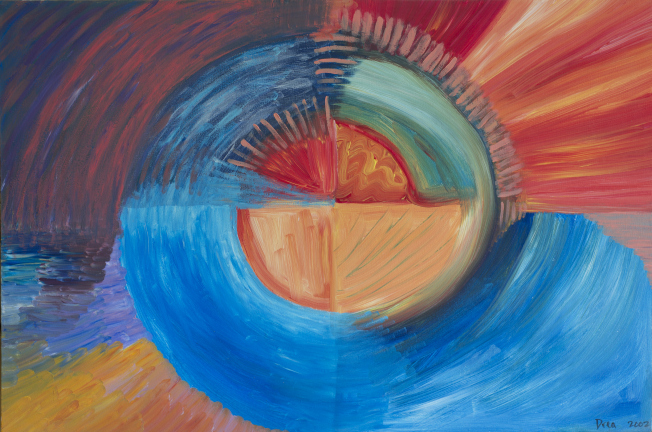
Four Sacred Directions 2002 by Drea

Four Sacred Directions 2002 by Drea

What I Have Learned So Far
by Mary Oliver

Meditation is old and honorable,
so why should I not sit, every morning of my life, on the hillside,
looking into the shining world? Because, properly
attended to, delight, as well as havoc, is suggestion.
Can one be passionate about the just, the
ideal, the sublime, and the holy, and yet commit
to no labor in its cause? I don’t think so.

All summations have a beginning, all effect has a
story, all kindness begins with the sown seed.
Thought buds toward radiance. The gospel of
light is the crossroads of – indolence, or action.

Be ignited, or be gone.

vitality of what will be

Standard

Lines Written in the Days of Growing Darkness
by Mary Oliver

Every year we have been
witness to it: how the
world descends
into a rich mash, in order that
it may resume.
And therefore
who would cry out

to the petals on the ground
to stay,
knowing, as we must,
how the vivacity of what was is married

to the vitality of what will be?
I don’t say
it’s easy, but
what else will do

if the love one claims to have for the world
be true?
So let us go on

though the sun be swinging east,
and the ponds be cold and black,
and the sweets of the year be doomed.

the pulling moon

Standard

Music
By Mary Oliver

I tied together
a few slender reeds, cut
notches to breathe across and made
such music you stood
shock still and then

followed as I wandered growing
moment by moment
slant-eyes and shaggy, my feet
slamming over the rocks, growing
hard as horn, and there

you were behind me, drowning
in the music, letting
the silver clasps out of your hair,
hurrying, taking off
your clothes.

I can’t remember
where this happened but I think
it was late summer when everything
is full of fire and rounding to fruition
and whatever doesn’t,
or resists,
must lie like a field of dark water under
the pulling moon,
tossing and tossing.

In the brutal elegance of cities
I have walked down
the halls of hotels

and heard this music behind
shut doors.

Do you think the heart
is accountable? Do you think the body
any more than a branch
of the honey locust tree,

hunting water,
hunching toward the sun,
shivering, when it feels
that good, into
white blossoms?

Or do you think there is a kind
of music, a certain strand
that lights up the otherwise
blunt wilderness of the body –
a furious
and unaccountable selectivity?

Ah well, anyway, whether or not
it was late summer, or even
in our part of the world, it is all
only a dream, I did not
turn into the lithe goat god. Nor did you come running
like that.

Did you?

to the spirit

Standard

SELF-PORTRAIT
by Mary Oliver

I wish I was twenty and in love with life
and still full of beans.

Onward, old legs!
There are the long, pale dunes; on the other side
the roses are blooming and finding their labor
no adversity to the spirit.

Upward, old legs! There are the roses, and there is the sea
shining like a song, like a body
I want to touch

though I’m not twenty
and won’t be again but ah! seventy. And still
in love with life. And still
full of beans.

honeyed centers

Standard

The Mango
By Mary Oliver

One evening

I met the mango.

At first there were four or five of them

in a bowl.

They looked like stones you find

in the rivers of Pennsylvania

when the waters are low.

That size, and almost round.

Mossy green.

But this was a rich house, and clever too.

After salmon and salads,

mangoes for everyone appeared on blue plates,

each one cut in half and scored

and shoved forward from its rind, like an orange flower,

cubist and juicy.

When I began to eat

things happened.

All through the sweetness I heard voices,

men and women talking about something—

another country, and trouble.

It wasn’t my language, but I understood enough.

Jungles, and death. The ships

leaving the harbors, their holds

filled with mangoes.

Children, brushing the flies away

from their hot faces

as they worked in the fields.

Men, and guns.

The voices all ran together

so that I tasted them in the taste of the mango,

a sharp gravel in the flesh.

Later, in the kitchen, I saw the stones

like torn-out tongues

embedded in the honeyed centers.

They were talking among themselves—

family news,

a few lines of a song

a mind and a heart

Standard

Messenger
by Mary Oliver

My work is loving the world.

Here the sunflowers, there the hummingbird—

equal seekers of sweetness.
Here the quickening yeast; there the blue plums.
Here the clam deep in the speckled sand.


Are my boots old? Is my coat torn?

Am I no longer young, and still not half-perfect? Let me
keep my mind on what matters,

which is my work,


which is mostly standing still and learning to be
astonished.

The phoebe, the delphinium.

The sheep in the pasture, and the pasture.

Which is mostly rejoicing, since all the ingredients are here,


which is gratitude, to be given a mind and a heart

and these body-clothes,

a mouth with which to give shouts of joy

to the moth and the wren, to the sleepy dug-up clam,

telling them all, over and over, how it is

that we live forever.

the miracle

Standard

The Hermit Crab

Mary Oliver

Once I looked inside
the darkness
of a shell folded like a pastry
and there was a fancy face—

or almost a face—
it turned away
and frisked up its brawny forearms
so quickly

against the light
and my looking in
I scarcely had time to see it,
gleaming

under the pure white roof
of old calcium
When I set it down, it hurried
along the tideline

of the sea,
which was slashing along as usual,
shouting and hissing
toward the future,

turning its back
with every tide on the past,
leaving the shore littered
every morning

with more ornaments of death—
what a pearly rubble
from which to choose a house
like a white flower—

and what a rebellion
to leap into it
and hold on,
connecting everything,

the past to the future—
which is of course the miracle—
which is the only argument there is
against the sea.

stone-hard beauty

Standard

The Poet with His Face in His Hands
by Mary Oliver

You want to cry aloud for your
mistakes. But to tell the truth the world
doesn’t need anymore of that sound.

So if you’re going to do it and can’t
stop yourself, if your pretty mouth can’t
hold it in, at least go by yourself across

the forty fields and the forty dark inclines
of rocks and water to the place where
the falls are flinging out their white sheets

like crazy, and there is a cave behind all that
jubilation and water fun and you can
stand there, under it, and roar all you

want and nothing will be disturbed; you can
drip with despair all afternoon and still,
on a green branch, its wings just lightly touched

by the passing foil of the water, the thrush,
puffing out its spotted breast, will sing
of the perfect, stone-hard beauty of everything.

idle and blessed

Standard

The Summer Day
By Mary Oliver

Who made the world?
Who made the swan, and the black bear?
Who made the grasshopper?
This grasshopper, I mean-
the one who has flung herself out of the grass,
the one who is eating sugar out of my hand,
who is moving her jaws back and forth instead of up and down-
who is gazing around with her enormous and complicated eyes.
Now she lifts her pale forearms and thoroughly washes her face.
Now she snaps her wings open, and floats away.
I don’t know exactly what a prayer is.
I do know how to pay attention, how to fall down
into the grass, how to kneel down in the grass,
how to be idle and blessed, how to stroll through the fields,
which is what I have been doing all day.
Tell me, what else should I have done?
Doesn’t everything die at last, and too soon?
Tell me, what is it you plan to do
with your one wild and precious life?