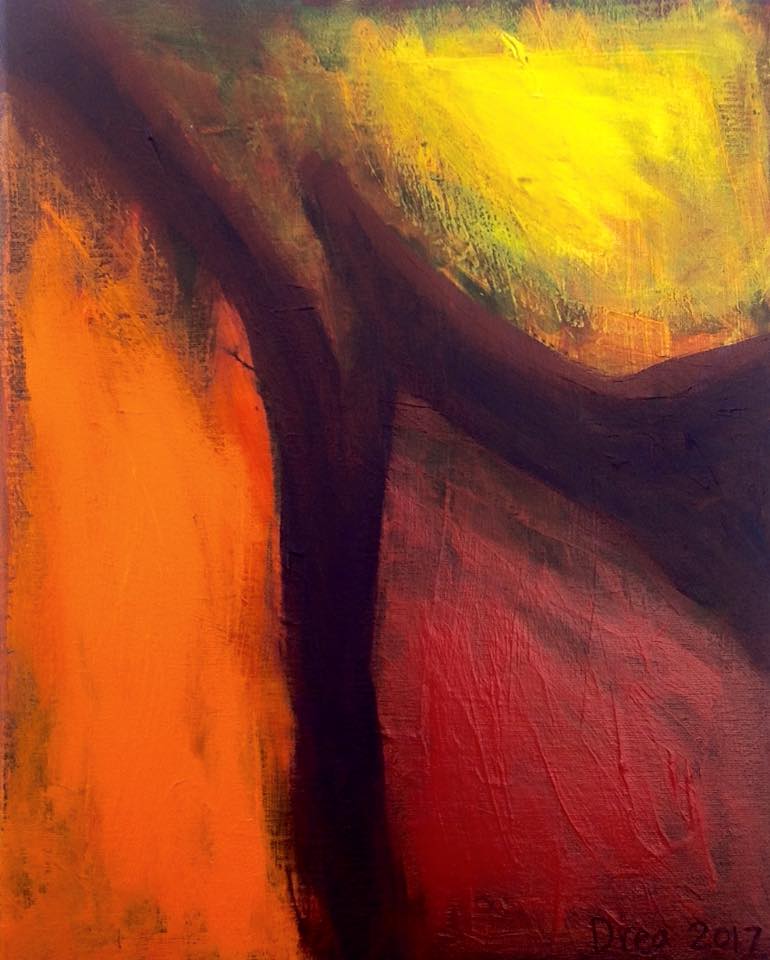
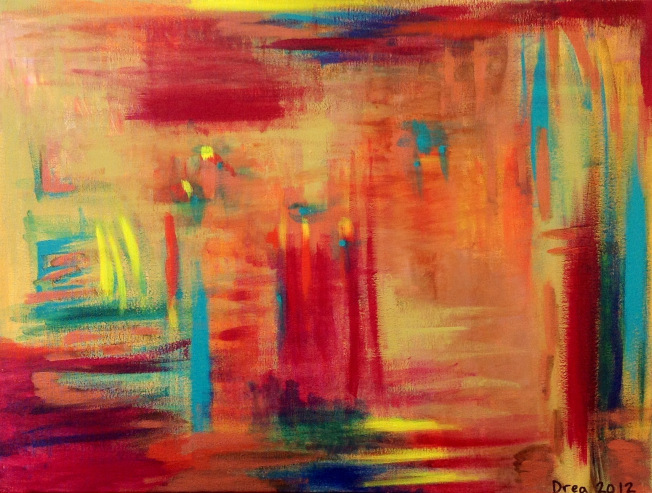
blazes the trail

Standard

Drea Art
dreajensengallery.artistwebsites.com
facebook.com/dreajensenart
virtualartistaltar.com

Skunk Cabbage
by Mary Oliver

And now as the iron rinds over
the ponds start dissolving,
you come, dreaming of ferns and flowers
and new leaves unfolding,
upon the brash
turnip-hearted skunk cabbage
slinging its bunches leaves up
through the chilling mud.
You kneel beside it. The smell
is lurid and flows out in the most
unabashed way, attracting
into itself a continual spattering
of protein. Appalling its rough
green caves, and the thought
of the thick root nested below, stubborn
and powerful as instinct!
But these are the woods you love,
where the secret name
of every death is life again – a miracle
wrought surely not of mere turning
but of dense and scalding reenactment. Not
tenderness, not longing, but daring and brawn
pull down the frozen waterfall, the past.
Ferns, leaves, flowers, the last subtle
refinements, elegant and easeful, wait
to rise and flourish.
What blazes the trail is not necessarily pretty.

attentiveness

Standard

Drea Art
dreajensengallery.artistwebsites.com
facebook.com/dreajensenart
virtualartistaltar.com

Heart Poem
By Mary Oliver

My heart, that used to pump along so pleasantly,
has come now to a different sort of music.

There is someone inside those red walls, irritated
and even, occasionally, irrational.

Years ago I was part of an orchestra; our conductor
was a wild man. He was forever rapping the music-
stand for silence. Then he would call out some
correction and we would begin again.

Now again it is the wild man.

I remember the music shattering, and our desperate
attentiveness.

Once he flung the baton over our heads and into
the midst of the players. It flew over the violins
and landed next to a bass fiddle. It flopped to the
floor. What silence! Then someone picked it up
and it was passed forward back to him. He rapped
the stand and raised his arms. Then we all breathed
again, and the music restarted.

beneficent rain

Standard


Drea Art

dreajensengallery.artistwebsites.com
facebook.com/dreajensenart
virtualartistaltar.com

One
by Mary Oliver

The mosquito is so small
it takes almost nothing to ruin it.
Each leaf, the same.
And the black ant, hurrying.
So many lives, so many fortunes!
Every morning, I walk softly and with forward glances
down to the ponds and through the pinewoods.
Mushrooms, even, have but a brief hour
before the slug creeps to the feast,
before the pine needles hustle down
under the bundles of harsh, beneficent rain.
How many, how many, how many
make up a world!
And then I think of that old idea: the singular
and the eternal.
One cup, in which everything is swirled
back to the color of the sea and sky.
Imagine it!
A shining cup, surely!
In the moment in which there is no wind
over your shoulder,
you stare down into it,
and there you are,
your own darling face, your own eyes.
And then the wind, not thinking of you, just passes by,
touching the ant, the mosquito, the leaf,
and you know what else!
How blue is the sea, how blue is the sky,
how blue and tiny and redeemable everything is, even you,
even your eyes, even your imagination.

body of a flower

Standard

Drea Art
dreajensengallery.artistwebsites.com
facebook.com/dreajensenart
virtualartistaltar.com

Reckless Poem
By Mary Oliver

Today again I am hardly myself.
It happens over and over.
It is heaven-sent.

It flows through me
like the blue wave.
Green leaves – you may believe this or not –
have once or twice
emerged from the tips of my fingers

somewhere
deep in the woods,
in the reckless seizure of spring.

Though, of course, I also know that other song,
the sweet passion of one-ness.

Just yesterday I watched an ant crossing a path, through the
tumbled pine needles she toiled.
And I thought: she will never live another life but this one.
And I thought: if she lives her life with all her strength
is she not wonderful and wise?
And I continued this up the miraculous pyramid of everything
until I came to myself.

And still, even in these northern woods, on these hills of sand,
I have flown from the other window of myself
to become white heron, blue whale,
red fox, hedgehog.
Oh, sometimes already my body has felt like the body of a flower!
Sometimes already my heart is a red parrot, perched
among strange, dark trees, flapping and screaming.

last night

Standard

Drea Art
dreajensengallery.artistwebsites.com
facebook.com/dreajensenart
virtualartistaltar.com

Last Night the Rain Spoke To Me
By Mary Oliver

Last night
the rain
spoke to me
slowly, saying,

what joy
to come falling
out of the brisk cloud,
to be happy again

in a new way
on the earth!
That’s what it said
as it dropped,

smelling of iron,
and vanished
like a dream of the ocean
into the branches

and the grass below.
Then it was over.
The sky cleared.
I was standing

under a tree.
The tree was a tree
with happy leaves,
and I was myself,

and there were stars in the sky
that were also themselves
at the moment,
at which moment

my right hand
was holding my left hand
which was holding the tree
which was filled with stars

and the soft rain—
imagine! imagine!
the wild and wondrous journeys
still to be ours.

like a packet of clouds

Standard

Drea Art
dreajensengallery.artistwebsites.com
facebook.com/dreajensenart
virtualartistaltar.com

On Losing a House
by Mary Oliver

1.

The bumble bees
know where their home is.
They have memorized
every stalk and leaf
of the field.
They fall from the air at
exactly
the right place,
they crawl
under the soft grasses,
they enter
the darkness
humming.

2.

Where will we go
with our table and chairs,
our bed,
our nine thousand books,
our TV, PC, VCR,
our cat
who is sixteen years old?
Where will we put down
our dishes and our blue carpets,
where will we put up
our rose-colored,
rice-paper
shades?

3.

We never saw
such a beautiful house,
though it dipped toward the sea,
though it shook and creaked,
though it said to the rain: come in!
and had a ghost—
at night she rattled the teacups
with her narrow hands,
then left the cupboard open—
and once she slipped—or maybe it wasn’t a slip—
and called to our cat, who ran to the empty room.
We only smiled.
Unwise! Unwise!

4.

O, what is money?
O, never in our lives have we thought
about money.
O, we have only a little money.
O, now in our sleep
we dream of finding money.
But someone else
already has money.
Money, money, money.
Someone else
can sign the papers,
can turn the key.
O dark, O heavy, O mossy money.

5.

Amazing
how the rich
don’t even
hesitate—up go the
sloping rooflines, out goes the
garden, down goes the crooked,
green tree, out goes the
old sink, and the little windows, and
there you have it—a house
like any other—and there goes
the ghost, and then another, they glide over
the water, away, waving and waving
their fog-colored hands.

6.

Don’t tell us
how to love, don’t tell us
how to grieve, or what
to grieve for, or how loss
shouldn’t sit down like a gray
bundle of dust in the deepest
pockets of our energy, don’t laugh at our belief
that money isn’t
everything, don’t tell us
how to behave in
anger, in longing, in loss, in home-
sickness, don’t tell us,
dear friends.

7.

Goodbye, house.
Goodbye, sweet and beautiful house,
we shouted, and it shouted back,
goodbye to you, and lifted itself
down from the town, and set off
like a packet of clouds across
the harbor’s sandy ring,
the tossing bell, the untowned point—and turned
lightly, wordlessly,
into the keep of the wind
where it floats still—
where it plunges and rises still
on the black and dreamy sea.
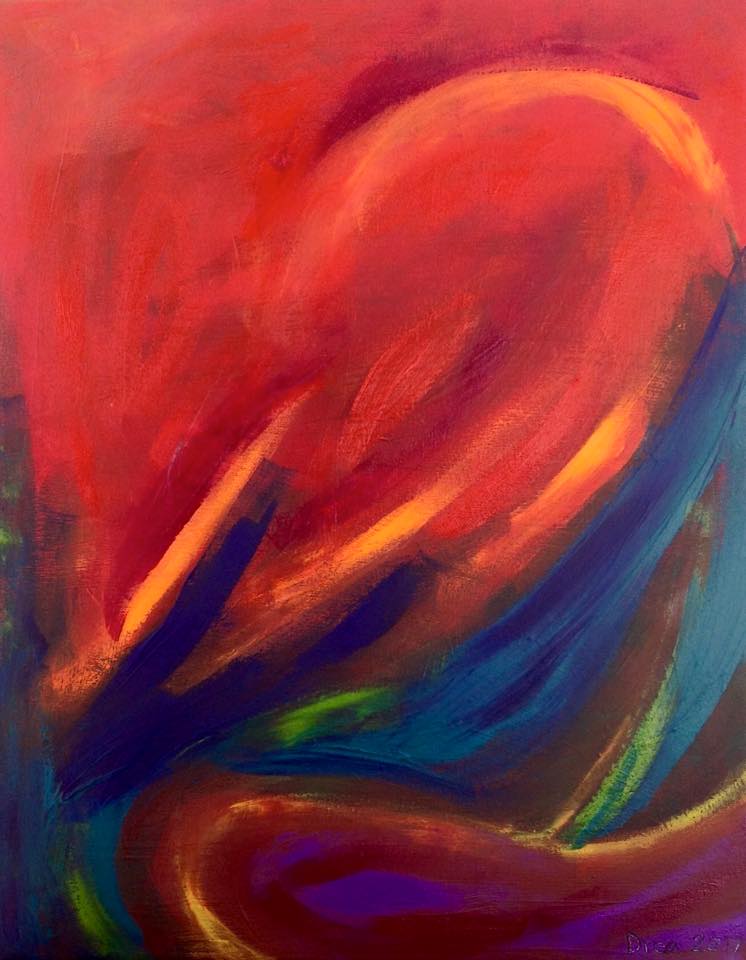
the deep fall

Standard

Drea Art
dreajensengallery.artistwebsites.com
facebook.com/dreajensenart
virtualartistaltar.com

Song for Autumn
By Mary Oliver

In the deep fall
don’t you imagine the leaves think how
comfortable it will be to touch
the earth instead of the
nothingness of air and the endless
freshets of wind? And don’t you think
the trees themselves, especially those with mossy,
warm caves, begin to think

of the birds that will come — six, a dozen — to sleep
inside their bodies? And don’t you hear
the goldenrod whispering goodbye,
the everlasting being crowned with the first
tuffets of snow? The pond
vanishes, and the white field over which
the fox runs so quickly brings out
its blue shadows. And the wind pumps its
bellows. And at evening especially,
the piled firewood shifts a little,
longing to be on its way.

dark hug of time

Standard

Drea Art
dreajensengallery.artistwebsites.com
facebook.com/dreajensenart
virtualartistaltar.com

Poem
by Mary Oliver

The spirit
likes to dress up like this:
ten fingers,
ten toes,

shoulders, and all the rest
at night
in the black branches
in the morning

in the blue branches
of the world.
It could float, of course,
but would rather

plumb rough mattter.
Airy and shapeless thing,
it needs
the metaphor of the body,

lime and appetite,
the oceanic fluids;
it needs the body’s world,
instinct

and imagination
and the dark hug of time
sweetness
and tangibility

to be understood,
to be more than pure light
that burns
where no one is —

so it enters us —
in the morning
shines from brute comfort
like a stitch of lightning;

and at night
lights up the deep and wondrous
drownings of the body
like a star.

joy and acclamation

Standard


Drea Art

dreajensengallery.artistwebsites.com
facebook.com/dreajensenart
virtualartistaltar.com

Mindful
by Mary Oliver

Every Day
I see or hear
something
that more or less

kills me
with delight,
that leaves me
like a needle

in the haystack
of light.
It is what I was born for—
to look, to listen,

to lose myself
inside this soft world—
to instruct myself
over and over

in joy,
and acclamation.
Nor am I talking
about the exceptional,

the fearful, the dreadful,
the very extravagant—
but of the ordinary,
the common, the very drab

the daily presentations.
Oh, good scholar,
I say to myself,
how can you help

but grow wise
with such teachings
as these—
the untrimmable light

of the world,
the ocean’s shine,
the prayers that are made
out of grass?

black ducks

Standard

Drea Art
dreajensengallery.artistwebsites.com
facebook.com/dreajensenart
virtualartistaltar.com

In the Storm
By Mary Oliver

Some black ducks
were shrugged up
on the shore.
It was snowing

hard, from the east,
and the sea
was in disorder.
Then some sanderlings,

five inches long
with beaks like wire,
flew in,
snowflakes on their backs,

and settled
in a row
behind the ducks —
whose backs were also

covered with snow —
so close
they were all but touching,
they were all but under

the roof of the duck’s tails,
so the wind, pretty much,
blew over them.
They stayed that way, motionless,

for maybe an hour,
then the sanderlings,
each a handful of feathers,
shifted, and were blown away

out over the water
which was still raging.
But, somehow,
they came back

and again the ducks,
like a feathered hedge,
let them
crouch there, and live.

If someone you didn’t know
told you this,
as I am telling you this,
would you believe it?

Belief isn’t always easy.
But this much I have learned —
if not enough else —
to live with my eyes open.

I know what everyone wants
is a miracle.
This wasn’t a miracle.
Unless, of course, kindness —

as now and again
some rare person has suggested —
is a miracle.
As surely it is.